

Theory of Change
Published. Reviewable. Challengeable. Built as a formal logic model — Impact, Outcomes, Outputs, Activities, and Inputs, constructed backward from the change ASF seeks, with assumptions tested at every transition.
Methodology. This Theory of Change follows the standard five-component logic model used in programme evaluation: Inputs, Activities, Outputs, Outcomes, and Impact, each transition carrying its own explicit, testable assumptions. It was constructed by backward mapping — starting from the Impact ASF seeks and working back through the chain that would have to hold for that Impact to occur — the method recommended for complex, multi-actor interventions. Developed and owned by the ASF International Standards Council; reviewed on the same three-year cycle as ASF’s published standards. Corrections and critique: info@accreditation.ge.
Impact — the change ASF exists to produce
Healthcare facilities that major accreditors do not reach — solo and micro practitioners, and facilities in limited-resource and conflict-affected settings — are held to, and visibly meet, the same patient-safety standard applied everywhere else; and the accreditation field has credible, published evidence on whether and how this is achieved.
Impact is long-term and system-level by definition: it is not something any single facility cycle, or even ASF alone, can fully claim credit for. Everything below is the chain of Outcomes, Outputs, Activities and Inputs ASF controls or directly influences in service of it.
The Logic Model
| Component | What it is, for ASF specifically |
|---|---|
| Inputs | Published ASF standards (9 modules, 802 criteria); the self-assessment tool; certified Coordinators, Monitors, and Surveyors (ASF-MON-STD-v1.1, ASF Surveyor Standard); the International Standards Council and Secretariat; the Public Standards Register; operating funds. |
| Activities | Quarterly Coordinator evidence collection; annual virtual Monitor milestone review and full physical Monitor verification at 3-year renewal; Surveyor escalation for disputed or complex cases; ADC decision-making; publication of standards, policies, and aggregate outcomes. |
| Outputs | A completed quarterly evidence file per facility; a Monitor verification record per cycle point; a written ADC decision with reasons; a public accreditation register entry; an annual aggregate outcomes report. |
| Outcomes | Facilities close identified criterion gaps within the quarter they are found, not at a once-a-year review; named professionals (Coordinator, Monitor) bear documented accountability for what they attest; continuous improvement becomes routine rather than performative. |
| Impact | See above — facilities otherwise excluded from accreditation meet the same patient-safety bar as everywhere else, with the evidence to show it. |
The If–Then Chain
The core discipline of a Theory of Change is the explicit conditional: if we do this, then we predict this will follow, because of this mechanism — stated plainly enough to be wrong. Four links, each resting on the one before it.
Inputs → Activities
If ASF certifies Coordinators and Monitors to a published standard, then they will carry out the quarterly evidence-and-verification cycle as specified — because the credential itself carries professional and contractual consequences for not doing so.
Assumes: a Coordinator and Monitor, once certified, will actually perform the cycle, not merely hold the credential. Tested by: ASF-MON-STD-v1.1 Standard F2 (professional liability, re-verification sampling) and the Field Testing Record’s completion rates.
Activities → Outputs
If Coordinators collect evidence quarterly and Monitors independently review it through an annual virtual milestone and a full physical verification at renewal, then each cycle will produce a complete evidence file and a signed verification record — because the two roles are structurally separated (ASF-MON-STD-v1.1, Standard F1) so neither can produce the output alone.
Assumes: this process reliably produces a complete, accurate record — not a partial or gamed one. Tested by: the inter/intra-Monitor reliability sampling in ASF-MON-STD-v1.1, Standard B5.
Outputs → Outcomes
If a verification record names each unmet criterion, its clinical significance, and the evidence required, then the facility will close that gap within the same quarter — because a specific, named action item is more actionable than a vague annual finding.
Assumes: documentation specificity actually changes facility behaviour on this timescale. This is the assumption least supported by independent evidence to date (see Comparator Evidence, below) — it is the central claim the pilot cohort evaluation is designed to test, not something ASF takes as already proven.
Outcomes → Impact
If facility-level outcomes improve and are published transparently, year over year, across a growing cohort, then the credibility and reach of accreditation extends to facilities major accreditors do not currently serve — because published, independently-evaluated evidence is what changes an outside body’s willingness to trust and fund the model, not ASF’s own claims about itself.
Assumes: aggregated, published evidence is the actual mechanism of credibility-building for donors, governments, and facilities — not merely a reporting formality. Tested by: the annual aggregate outcomes report and independent academic evaluation described below.
What We Assume — and What We Do Not
| We assume | We do not assume |
|---|---|
| Named accountability changes behaviour more reliably than anonymous compliance | That all facilities will act in good faith — hence the QA layer |
| Quarterly evidence accumulation produces better outcomes than annual snapshots | That self-assessment alone is sufficient — hence the Monitor |
| Affordable access increases participation and therefore system-wide impact | That accreditation automatically improves clinical outcomes — the evidence base is our task to build |
| Local language assessment removes a material barrier for most of the world | That the model is final — it will be revised based on evidence from the pilot cohort |
What the Comparator Evidence Says
ASF’s theory of change is not written in a vacuum. The effectiveness of healthcare accreditation generally has its own research literature, and ASF’s model is designed with that literature’s findings — and its gaps — in view.
- The evidence is real but mixed, not settled. Greenfield and Braithwaite’s systematic review of accreditation research found consistent evidence that accreditation promotes organisational change and professional development, but inconsistent evidence on financial impact and direct quality measures — a finding later studies have continued to reproduce rather than resolve.
- Specific outcome studies point both ways. A mixed-methods study at King Fahd Hospital, Khobar, found measurable improvement in 9 of 12 quality outcomes following JCI accreditation; other peer-reviewed studies of JCI-accredited hospitals have found limited or inconsistent difference versus non-accredited comparators. ASF takes both kinds of finding as reason to measure its own outcomes directly, not to assume either result.
- Transparency about the evidence base is itself a recognised best practice. Joint Commission maintains a public Value of Accreditation and Certification Literature Database, synthesising the published research — favourable and unfavourable — on its own model’s effectiveness. ASF’s commitment to publish pilot-cohort outcomes regardless of findings follows the same logic.
Sources: Greenfield D, Braithwaite J. Health sector accreditation research: a systematic review. Int J Qual Health Care. 2008;20(3):172–183. Greenfield D, Braithwaite J. Developing the evidence base for accreditation of healthcare organisations: a call for transparency and innovation. BMJ Qual Saf. 2009;18(3):162–163. Al-Awa B, et al. International accreditation and its effect on quality outcomes. King Fahd Hospital, Khobar — published mixed-methods study. Joint Commission, Value of Accreditation and Certification Literature Database (ongoing).
The Evidence Commitment
The pilot cohort — the first facilities to complete a full ASF accreditation cycle — will be independently evaluated by an academic research board. The evaluation protocol will be pre-registered with an open-science registry before the first pilot cohort completes its cycle. Results will be submitted to a peer-reviewed journal regardless of findings. Given what the wider literature shows — real but inconsistent evidence across two decades of accreditation research — ASF treats a null or mixed result as a genuinely possible outcome, not a formality. If the evidence does not support the theory of change, the model will be revised.
We invite academic review and critique: info@accreditation.ge
Developed and owned by the ASF International Standards Council. First published 2026; this logic-model structure adopted 6 October 2026. Reviewed on ASF’s standard three-year cycle, or sooner if pilot-cohort evidence requires revision. Methodology: five-component logic model (Inputs, Activities, Outputs, Outcomes, Impact), constructed by backward mapping from Impact, consistent with standard programme-evaluation practice.
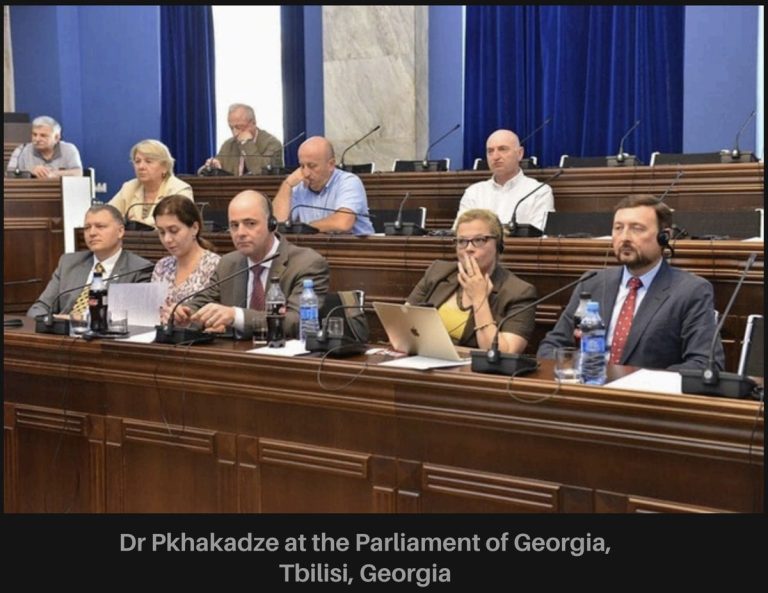
UN IAP members at Parliament of Georgia — evidence-based accountability at the UN level
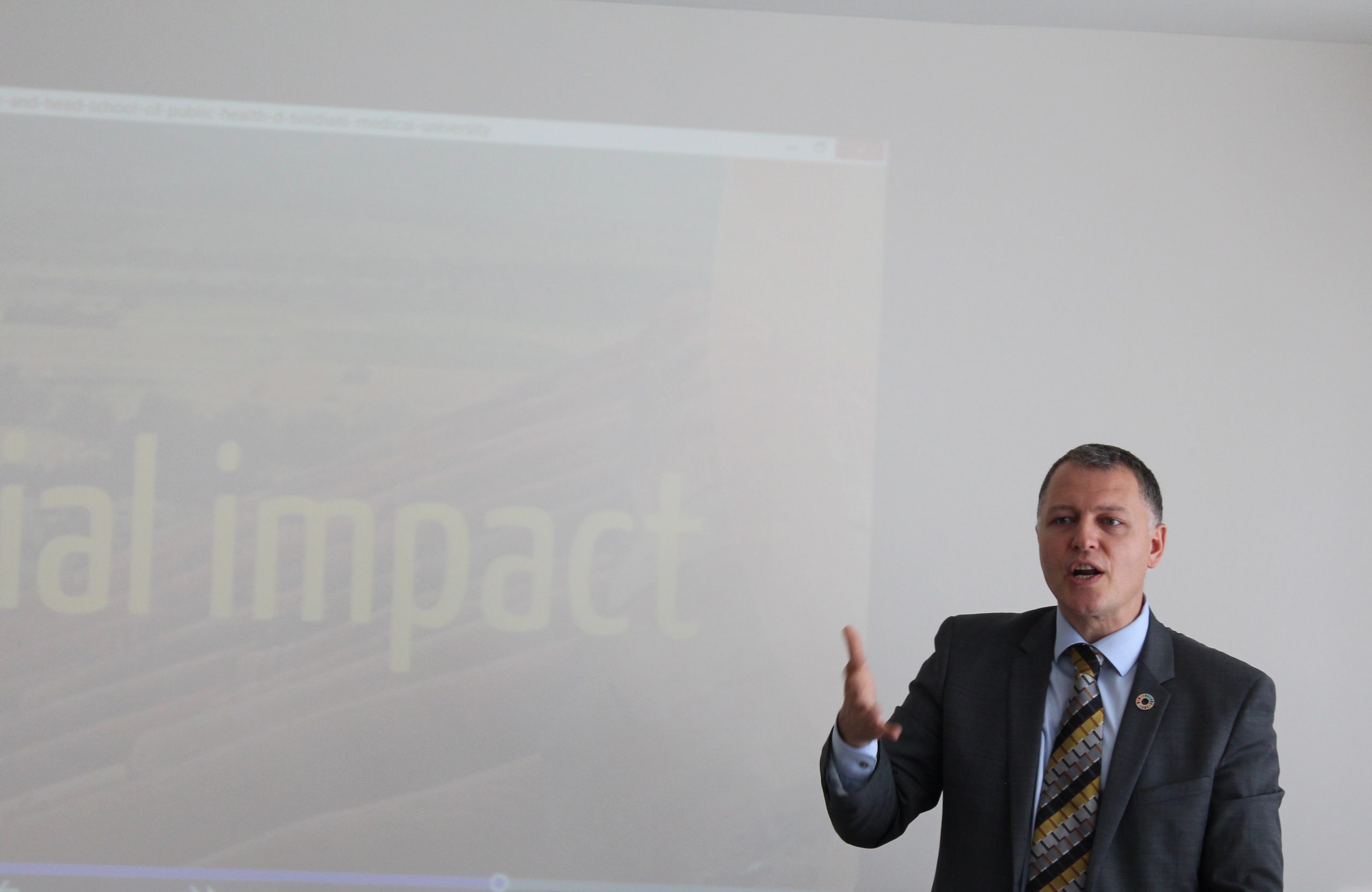
DTMU, Tbilisi, 2017 — theory of change presented to academic and policy audience