
Quality Assurance of the System
Any accreditation system can be gamed. The question is whether the system has detection mechanisms and real consequences. ASF has four independent layers of quality assurance — each designed to catch a different failure mode.
The design principle: The system is built on the assumption that some facilities will try to game it and some Monitors will be too lenient. The four QA layers operate independently of each other — compromising one does not disable the others.
1. Random Re-Verification Programme
5% of accredited facilities per year, selected by ASF algorithm, receive an unannounced re-verification by an ASF-appointed Monitor — not the facility’s own Monitor, not one known to the facility. The facility receives less than 24 hours notice.
| Finding | Consequence for facility | Consequence for Monitor |
|---|---|---|
| Consistent with full verification report | None — confirms system integrity | Positive track record |
| Minor discrepancy | Improvement note issued | Recorded, monitored |
| Significant discrepancy | Accreditation under formal review | Credential suspended pending investigation |
| Falsification confirmed | Suspended; 12-month exclusion minimum; public registry updated | Credential revoked; 5-year exclusion minimum |
2. Mandatory Adverse Event Reporting
Any serious adverse event at an ASF-accredited facility — patient death attributable to system failure, never event, serious preventable harm — must be notified to ASF within 72 hours of discovery; a full written report must follow within 30 days. ASF reviews whether the event relates to any accredited criterion.
- If the event relates to an accredited criterion: mandatory re-verification triggered automatically
- If re-verification finds the criterion was not genuinely met: accreditation under review; Monitor credential under investigation
- All adverse event reports are reviewed annually in aggregate and published in the ASF Annual Accountability Report
3. Patient and Public Reporting Channel
Any person — patient, family member, staff, regulator, or member of the public — can submit a concern about an ASF-accredited facility through a confidential channel. Identity is protected. ASF responds within 30 days.
- Substantive concern (supported by specific allegation): triggers unannounced re-verification
- Concern about Monitor conduct: referred to ADC for investigation
- Anonymous concerns: reviewed by ASF quality team; re-verification triggered if pattern is identified
4. Monitor Performance Tracking
The ADC maintains a longitudinal performance record for every certified Monitor — every verification they have conducted, every re-verification outcome that touched their facilities.
| Trigger | Action |
|---|---|
| 1 significant discrepancy | Formal note on Monitor record |
| 2 significant discrepancies | Mandatory supervision of next verification |
| 3 significant discrepancies | Credential suspension; formal ADC investigation |
| Confirmed falsification | Credential revoked; 5-year exclusion; published on ASF registry |
Rotation enforcement: Internal Monitor maximum 3 years at one facility. External Monitor maximum 5 years per facility. Mandatory gap of one full cycle before return.

ASF accreditation certificates — evidence of a complete, verified quality cycle
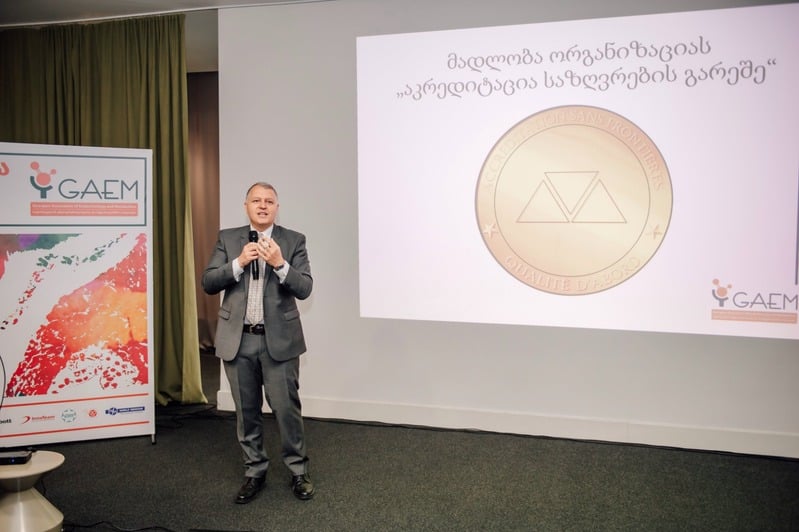
GAEM International Conference, Tbilisi, 2022 — ASF publicly recognised by the Georgian medical community