
An independent customer council
and neutral ombudsman — for any fitness club.
You do not need to be accredited. You do not even need to be an ASF member. You need only to want to hear the truth — from a body the customer trusts because it is not the fitness club.
Why fitness club feedback fails.
Every fitness club has a feedback form. Customers fill it in carefully — because the club they belong to will read it, and they may need that fitness club again. So the form says “everything was fine.” The real story goes to Facebook. Management learns about the problem from a viral post two days later.
The fitness club’s own form goes into a black hole. The anger goes public. Neither outcome helps the next customer.
The fix is structural, not technical. Customers speak honestly when the listener is not the fitness club. That listener is ASF.
The same structural logic that makes an independent channel work for customers works for members: people are honest with a neutral listener in a way they rarely are with the business that serves them, because they have nothing to protect by staying quiet.
An unanswered complaint doesn’t disappear — it goes to a review site or social media instead, later and angrier. A neutral intermediary that closes the loop in writing protects the member and the facility alike.
One QR code. Straight to a neutral body.
The QR code
We place a QR code at reception, in the changing rooms, and in your welcome pack. A customer scans it and submits — complaint, praise, question, idea. Anonymity is allowed. The message goes directly to ASF. It never passes through the fitness club.
The neutral answer
ASF acknowledges in writing within two working days and responds substantively within five. We take neither the fitness club’s side nor the customer’s. We mediate — including feedback that first appeared on social media — and we close every case in writing.
The learning loop
The fitness club receives a monthly Customer Voice report: themes, severity coding, praise passed to the team by name, and the issues that need fixing — analysed with an internationally validated complaint taxonomy, comparable month to month.
Independence · Impartiality · Informality · Confidentiality
ASF holds no stake in any outcome. We have no disciplinary role over the facility. We are not the fitness club’s agent and we are not the customer’s advocate — we are the neutral facilitator between them. These four principles are drawn from international ombuds practice (International Ombuds Association Standards of Practice) and are the governance spine of this service. A breach of any one of them destroys the trust the service depends on.
A real customer council.
We recruit, train and convene a council of real customers — never controlled by the fitness club. The council meets quarterly, reviews the Customer Voice reports, proposes improvements, and publishes what changed. Fitness club representation sits at the table. Fitness club management does not control the agenda.
This is the same model ASF already runs for patient councils in Georgia, documented publicly at pacienti.ge — now adapted for Fitness & Wellness. Every session minuted. Every outcome published, the same way, from the first council this creates.
Standalone service
Customer Voice is available as a standalone service — you do not need to be an ASF member or pursuing accreditation. Pricing is indexed to facility size and published on request.
For ASF member facilities, Customer Voice is included in the membership fee. The customer council is convened from the first month of membership.
Print to share.
The method — one meeting a month, in seven steps
The method is deliberately simple. One council. One meeting a month, sixty to ninety minutes. ASF, delivered in Georgia through the Public Health Institute of Georgia (PHIG), is the secretariat — not the chair, not a member, not the club’s agent and not the customer’s advocate. The council belongs to the customers; the fitness club sits at the table; the secretariat makes it run. What makes it unusual is the order of operations: the meeting is built on a report of everything customers said in the previous month, and the report goes to the fitness club first — so that by the time the council meets, every concern has a verified account and, where possible, an answer.
Roles
| Who | How many | What they do | What they never do |
|---|---|---|---|
| Members and customers | 3–6 (max 7) | Members of the council. Review the month’s report, ask, propose, decide what to raise. Chair from among themselves. | Represent the fitness club |
| Fitness club representatives | 1–2 | Sit at the table. Explain what was found and what was done. Take actions away. | Chair, vote, control the agenda, or see who complained when anonymity was asked |
| ASF secretariat (PHIG, Georgia) | 1 | Collects every piece of feedback, writes the report, checks it with the fitness club, convenes, records, tracks actions, runs the education session, closes the loop with each customer. | Take sides. Discipline anyone. Decide outcomes. Hold a stake in any result |
The monthly cycle
| Step | When | What happens | Output |
|---|---|---|---|
| 1 · Collect | All month | Every piece of feedback, from every source, lands with ASF: QR code, hotline, online form, email, paper forms, WhatsApp, social-media posts and tags. Praise as well as complaints. Each gets a case number. | One register, one place |
| 2 · Report | Month end | ASF writes the monthly Customer Voice report: every case, themed and severity-coded with a validated taxonomy; praise by name; what was asked, what is open. | Draft report |
| 3 · Verify with the fitness club | Days 1–5 | The draft goes to the club’s liaison first. This is the conflict-of-interest safeguard in reverse: customers sometimes report inaccurately or without context, and the fitness club must have the chance to clarify, correct and say what it has already done. Nothing is softened; facts are checked. | Verified report with the fitness club’s responses |
| 4 · Council meeting, part one | Days 7–10 · 40–60 min | The verified report is presented to the council. Positives and negatives. What has been done. What will be done, by whom, by when — and where an answer can already be given to the customer. | Action log with owners and dates |
| 5 · Close the loop | Within 5 working days of the meeting | Every customer who raised a concern hears back, in writing, with what was found and what changed. This is the step that matters most. | Written answer to each customer |
| 6 · Council meeting, part two | Same meeting · 30 min | Customer education: one session, one topic, chosen from what the month’s feedback shows customers most need to know — membership rights, waivers, safety guidelines, cancellation, how to ask questions. | Education record |
| 7 · Publish | After the meeting | The council record, minus anything identifying, goes on the public archive. Actions carried to next month’s report until closed. | Public record |

Recruitment, membership and the ground rules
The fitness club recruits, openly and continuously. The invitation goes out through every channel the fitness club already uses — its website, its social media, and a notice at the entrance or in the customer corner — and it stays up, because members come and go: a customer joins, trains for a season, moves on. The council is small by design. Three members is the minimum for a small club; six is the working maximum, occasionally seven. Beyond that, honest discussion becomes management.
| Rule | How it works |
|---|---|
| Recruitment | Announced by the fitness club on its website, social media and at the entrance/customer corner; open to any current or former customer or family member; rolling — new members join as others leave |
| Size | Minimum 3 (small club) · working maximum 6 · never more than 7 |
| Chair | A customer, elected by the members. Rotates — no one chairs for more than one year |
| Fitness club seat | One or two: usually the head of quality and the head of reception or administration — the people who have the first contact with customers and the authority to fix what they hear |
| Secretariat | ASF, via PHIG in Georgia: one person, precise and persistent. Keeps the register, writes the report, chases the actions, makes the sessions worth attending, and follows up with members who miss a meeting |
| Channel between meetings | A WhatsApp group of members, fitness club seat and secretariat — for reminders, sharing the report and materials, and questions between meetings. Not for individual cases |
| Term | No fixed term for members; chair rotates yearly; a member who misses three consecutive meetings is asked whether they wish to continue |
The agreements — three documents, plain language
Trust needs paper. Three signed documents, all short, all plain-language:
The agreements protect three things at once: the customers (their privacy and their freedom to speak), the fitness club (against damage from what is said in a confidential forum), and the council itself (because a body that leaks is a body no one speaks to). They are drafted under French law with a local-law annex where the council operates outside France.
How it differs from other council models
| Hospital-run Patient and Family Advisory Councils (North America) | Statutory consumer bodies (UK Healthwatch, Australian consumer committees) | ASF Customer Voice council | |
|---|---|---|---|
| Who runs it | The fitness club’s customer-experience office | An external body, at system or regional level | An independent secretariat, at facility level |
| What the agenda is built on | Topics the fitness club brings | Surveys, visits, system issues | Every piece of feedback from the last month, verified with the fitness club first |
| Loop closure to the individual | Rarely structured | Not the body’s role | Every case, in writing, within 5 working days |
| Education | Occasional | Campaigns | Every meeting, topic chosen from the month’s feedback |
| Time required | Quarterly, 2–3 hours | Varies | Monthly, 60–90 minutes |
| Public record | Internal minutes | Published reports | Published council record (model proven at pacienti.ge for patient councils) |
The Customer Voice Toolkit — download, adapt, run
Eight documents, every one with worked examples, every one also as an editable Word file. These are the original Patient Voice documents the method was built on — written to be adapted, and every one explicitly permits it. Swap “patient” for “member” or “customer,” and “hospital” for “fitness club,” exactly as this page does, and the method transfers directly. Free to reuse with attribution and a note of what was changed.
Built on proven practice, not invented for this page
Customer Voice draws on the same structural principle that makes independent complaint handling work in regulated sectors worldwide: an external first point of contact, published response-time commitments, and a body with no stake in the outcome. It’s the identical reasoning ASF already applies for patients in healthcare settings, adapted here for the first time for Fitness & Wellness — not a new theory, but a proven one, used in a new context.
The ASF Customer Charter — seven rights, displayed in every facility
The same seven rights ASF already publishes for patients, adapted here for Fitness & Wellness, and assessed in the ASF standards.
Four ways to reach us — none of them through the fitness club
What happens, and by when
Timelines are commitments, measured and published in the annual summary.
| Step | What happens | When |
|---|---|---|
| 1 | Case reference issued to the customer | Immediately (form, hotline, WhatsApp) or same day (email) |
| 2 | Written acknowledgement, track assigned (concern about care · praise · question · idea) | Within 2 working days |
| 3 | ASF contacts the facility’s named liaison with the substance — never the customer’s identity if anonymity was requested | Within 3 working days |
| 4 | Substantive written response to the customer; for complex cases, a written plan with dates | Within 5 working days |
| 5 | Mediation where needed — both sides heard before any conclusion | Within 20 working days for straightforward cases |
| 6 | Case closed in writing to customer and facility; learning recorded in the taxonomy | At resolution; complex cases within 3 months with monthly updates |
| 7 | Immediate customer danger | Escalated the same day under the Sentinel Event Policy — no queue |
Training we provide
What you receive
How it connects to accreditation
Customer Voice is a service in its own right, and for Fitness & Wellness facilities it’s also how criterion 7.6 of the standard is met — the requirement for an independent feedback channel outside the facility’s own management, not only an internal one. A facility running Customer Voice has that evidence produced for it every month, independently. For ASF member facilities it’s included as part of membership; for facilities not pursuing accreditation, pricing follows the same model as the Patient Voice Package already published in ASF’s Local Advisory Services catalogue.
Evidence that it works
Since January 2024 the same council model has run in hospitals in Tbilisi, Kutaisi and Batumi through the ASF/PHIG alliance, with the first Batumi council bringing five facilities of one group to a single table. Those meetings, education sessions and initiatives are documented publicly, the working record, not a brochure, on pacienti.ge. The model was tested in a health system with no tradition of independent patient voice at all; that it worked there, starting from nothing, is the strongest evidence it will work for a fitness club starting from nothing too.
Track record — the Customer Council initiative, Georgia, since January 2024
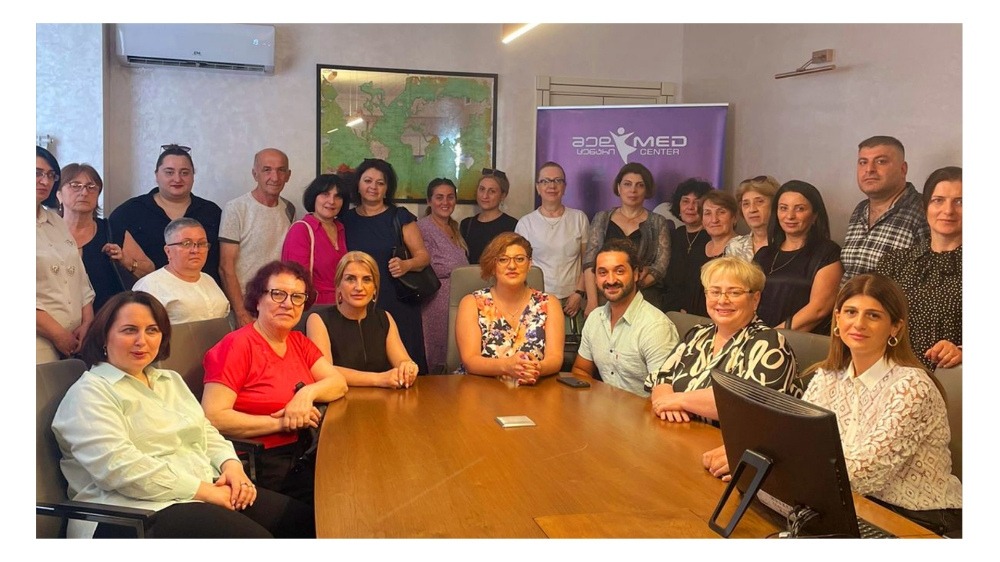
Customer Voice is not a new idea built from nothing: it is the same council model, launched in Georgia in January 2024 through the ASF/PHIG alliance for hospitals, adapted here for the first time for Fitness & Wellness. A running council meets monthly — three to six members and family, one or two facility representatives, one secretariat representative — with the secretariat handling logistics, records, and every action item. The method itself has run in hospitals across Tbilisi, Kutaisi and Batumi, with measurable improvements in patient satisfaction — proof the model works, not a promise. Fitness & Wellness Customer Councils use the identical seven-step method, now available for the first time to clubs like yours.
Free resources for every facility
Developed with the Public Health Institute of Georgia and David Tvildiani Medical University because fitness clubs asked. Free to print, use and translate; keep the ASF mark.
>